Last updated Mar 30, 2026
Fences keep children and pets inside your yard while keeping intruders or unwanted critters out. They can also be useful for privacy and noise reduction. Once you’ve decided that you want to build a fence, the biggest question is: do you hire a contractor or do the work yourself?
Do it Yourself, with the Right Equipment
If you choose to install a fence yourself, make sure you have more than enough time to work on it. There’s bound to be unexpected obstacles, so project completion will likely take longer than anticipated. You’ll also need to familiarize yourself with any local zoning ordinances that regulate fencing.
If you go your own way, see if you can find a neighbor, friend or relative who has completed a similar job so you can lean on them for advice and maybe a helping hand. For any DIY fencing project, it is imperative that you call 811 to have underground utilities marked. This will minimize your liability and help keep you safe from dangerous digging accidents.
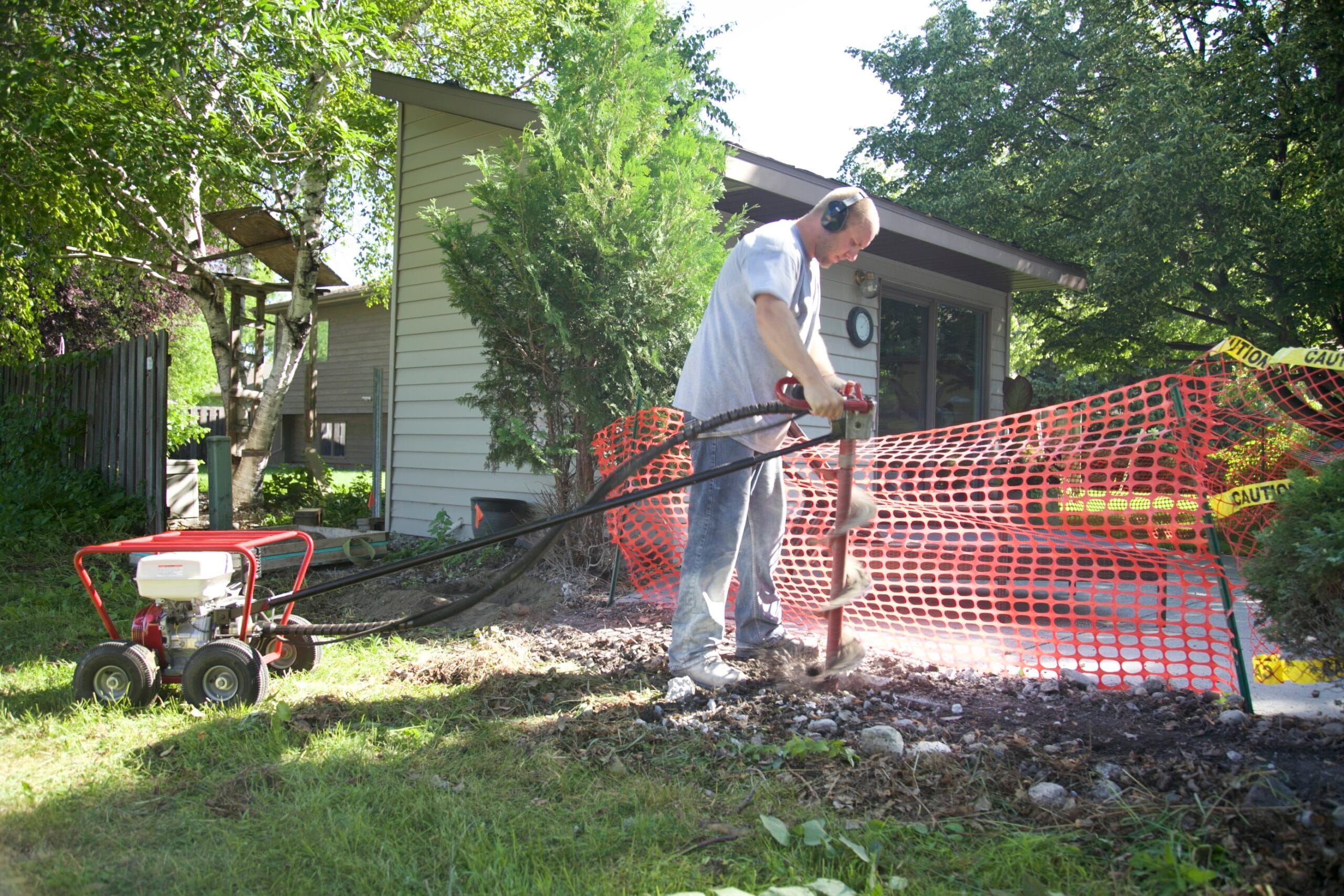
Fencing is hard work, but it’s easier when you have the right equipment. Little Beaver earth drills are versatile, and you may want to consider buying one if you anticipate more projects, such as running wires under your sidewalk for lighting, running pipe under your driveway for irrigation, planting a garden or installing drain tile. But if you only foresee needing an earth drill for this single task, there are rental centers nationwide that offer our equipment.
Mechanical earth drills are the most popular choice among fencing contractors, as they offer swift speed and light weight. This model is ideal for sandy or loamy soils with few obstructions.
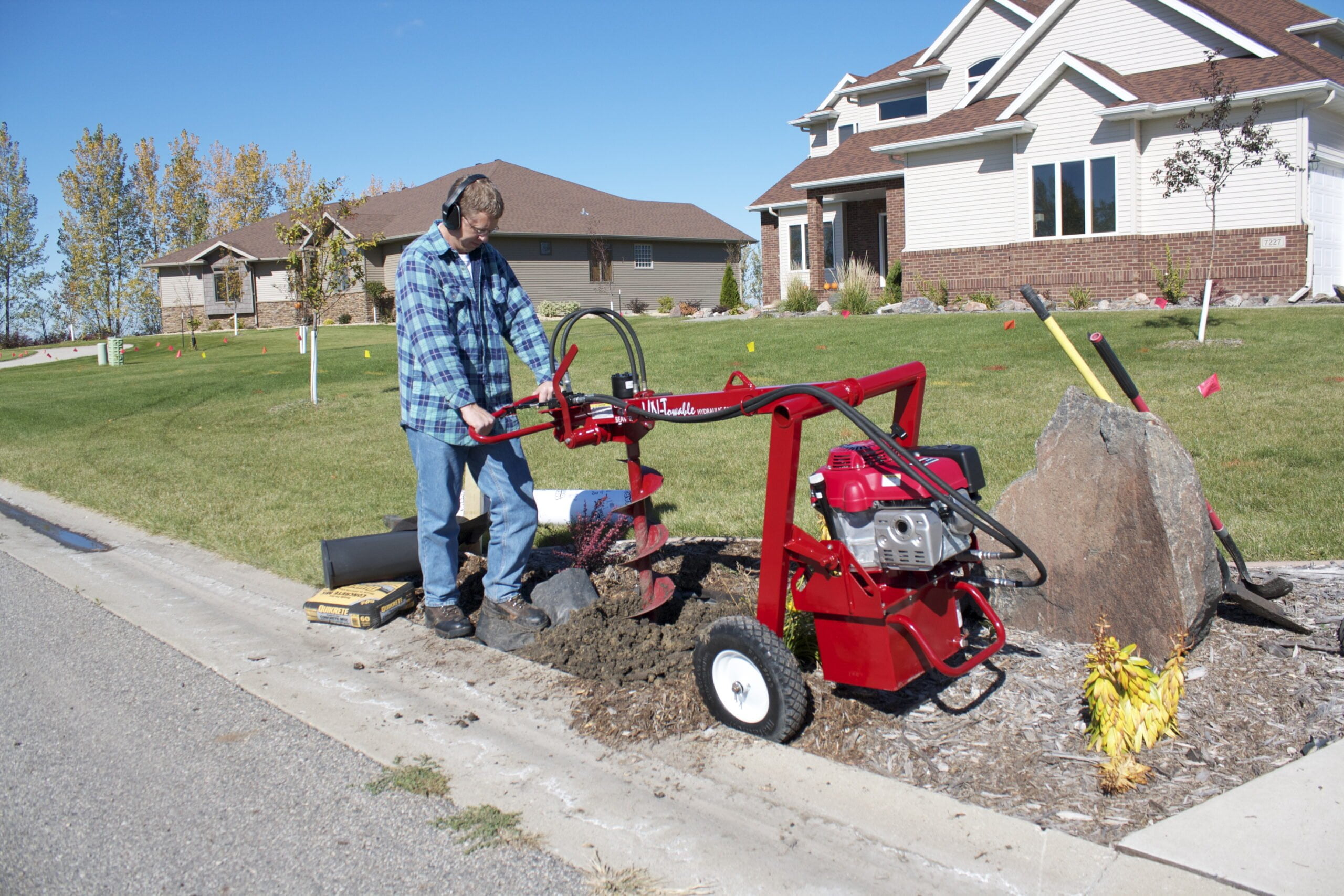
Hydraulic earth drills are best for areas with exceptionally rocky sediment or hard clay. Little Beaver Towable Earth Drills can be a convenient option for pulling the equipment right up to your work area, while our UN-Towable Earth Drills can be stowed in the back of a pick-up truck or SUV. Both are hydraulic.
Mechanical and Hydraulic Earth Drills speed up the fencing process as they can drill a hole in less than one minute with minimal effort. Our models also make drilling safer for one person. Little Beaver’s steel torque tube protects the operator from dangerous kickback by transferring that kickback from the auger to the power source.
Hire a Contractor
Naturally, contractors know where to find the highest quality materials, so you’re more likely to get a top-notch product in that regard. Their many years of experience equip them to handle difficult scenarios with ease. Is the area you seek to fence flat or hilly with a steep terrace? This may be difficult to navigate on your own.
Ask yourself if this fence is a temporary fix or a structure that you hope will last for many years to come. An error made during a DIY installation might compromise the integrity of the rest of the fence. Given their level of experience, a contractor is more likely to get it right the first time. If the fence will be especially large or one that requires going deep underground, you might be better off hiring a professional. Read online reviews and seek recommendations from friends to ensure you hire someone who is safe and reliable.
Fencing Finale
There are many factors to consider when deciding between DIY and hiring a contractor for your fencing project: your time, budget and handyman abilities. If you do the work yourself, Little Beaver Earth Drills will help you achieve your project goals effectively. We also have a vast library of informative blogs on our website to help guide you through the process and answer any questions you might have. If you have questions, contact us directly by phone or email.

Last updated Mar 27, 2026
Maximize potential while minimizing expenses
Providing quality services while maintaining a healthy bottom line will forever be high on a contractor’s priority list. Renting drilling equipment is one way to maximize productivity and potential while minimizing expenses. For specialty projects and testing the waters on new services, equipment rental can be a cost-efficient option if you’re looking to provide more without over-investing.
There are endless opportunities that rental centers can help a fencing crew tackle. For example, rental centers offer a range of machines and attachments for safe one-person operation. Availability will vary from center to center, but you can often find our Mechanical and Hydraulic earth drills as well as the Kwik-Trench in a variety of sizes — perfectly scalable for construction and landscape projects.
Drilling Through Soft Soil
Looking for a post-hole auger that is lightweight, high-speed and digs quickly and cleanly? See what your local rental center has for mechanical earth augers. Little Beaver Mechanical Earth Drills power through sand, silt and loam, creating clean 6- to 8-inch diameter holes for applications such as fencing, deck building, landscaping and more. Digging a post hole takes less than a minute, meaning a crew can accomplish a lot with just a two-day rental. Need to bore under something? With Little Beaver’s optional horizontal boring attachments, you can easily rent the equipment to bore under sidewalks and driveways to install landscape lighting, water systems and much more.
Tackling Tough Soil
For tougher soils — like clay, rock or frozen ground — a Little Beaver Hydraulic Earth Drill may be the best choice. These machines offer more power than mechanical drills, and our models still allow one-person drilling. With their extra torque, hydraulic earth drills can handle augers up to 16 inches in diameter and can drill depths of up to 30 feet with the right auger. Little Beaver Hydraulic Earth Drills also include a reversible feature that makes them ideal for quick removal from the ground.
With even more power and potential, UN-Towable and Towable Earth Drills have a balanced torque-free design to enhance operator safety when drilling through uneven terrain. These earth augers are ideal for fencing, landscaping, decks, sign installation and recreational applications.
Effortless Trenching
Mini trencher machines at your local rental center are a great solution for digging trenches. Little Beaver’s Kwik-Trench can dig a 12-inch-deep trench at speeds of up to 30 feet per minute. They make installing lawn sprinklers, electric dog fencing, low voltage wiring, plumbing and drainage lines and wire cable the work of an afternoon. Silt fencing, landscape edging, root pruning and bed preparation also become faster and less backbreaking.
Can Renting Work for Me?
When it comes to one-time projects — those special requests that pop up in conjunction with a current project but aren’t something you’re looking to offer regularly — renting lets crews get the job done without a costly, long-term commitment. Depending on the length of the rental, the team can even knock out several small projects with the same machine, optimizing efficiency. Planning will help ensure you get the most out of the rental.
Repeatedly renting the same equipment can also be cost-efficient, to a point. It’s a great way for small businesses looking to expand their services to test out different machines and attachments before committing. For equipment you don’t plan on using every day, renting rather than buying saves money since the rental center takes on the initial cost of the machine and any maintenance needs. However, it’s important to keep in mind there’s a limit to the cost benefits of renting if your crew is frequently using a specific machine.
When used wisely, renting can be a valuable tool for contractors looking to provide more while spending less. The fastest way to assess rental potential is by taking a trip to your local rental center or talking to the manufacturers who supply their equipment. We’re happy to answer your questions. Contact our team today.

Last updated Mar 27, 2026
Boost your ROI with One-Man Drills
Between capitalizing on opportunities, attracting and retaining customers, hiring and motivating good employees, fending off the competition and managing expenses, the margin for error is small when it comes to running a business.
Labor and equipment costs are two of the most impactful variables affecting profits for contractors. For this reason, discovering efficient and durable equipment that can also reduce labor costs, like Little Beaver’s Mechanical Earth Drills, is a game-changer.
Maximizing Manpower
For starters, wages, benefits and payroll taxes add up quickly. This is why labor is often a contractor’s biggest expense. If you run a high-volume digging business, looking at the equipment your crew uses to dig holes is one of the best ways to reduce costs and increase profits.
A lot of contractors use mechanical earth drills to dig holes. While these drills can provide high auger speeds — up to 360 rpm — for fast hole digging, most come with a major drawback. Many fail to protect operators from the torque and kickback associated with the drill’s power and speed and, as a result, require two operators to mitigate the risk of injury from an out-of-control drill.
Two or three employees often make up an entire crew, so projects can get off to a slow start when two are tied up digging holes. This is the norm for many contractors. But, with Little Beaver earth drills, it doesn’t have to be. Little Beaver’s Mechanical Earth Drills feature engines that are mounted on a separate carrier attached to the drill’s handles via a steel torque tube. The drill’s torque and kickback are transferred to the engine carrier, as opposed to the operator, making safe one-person operation possible.
With equipment that allows for one-person digging, you can free up that second operator to complete other portions of the job. And, the manageable size and efficient design of Little Beaver Mechanical Drills decreases labor costs, increases your crew’s capacity to take on more work and jobs get completed faster.
The Proof Is in The Profit
A single residential fence project — an 80- by 40-foot standard backyard wood fence with 8-foot-long sections — requires approximately 20 holes. From unloading the drill to finishing the final hole, this portion of the job takes about an hour for two people to complete. With a Little Beaver Mechanical Earth Drill, however, the work can be completed in roughly half the time while the second person starts on other aspects of the project, such as unloading materials and placing posts.
Ultimately, this can shave as much as 30 to 45 minutes — more for larger jobs — off of the total time it takes to finish the project. Although it may not sound significant, 30 minutes per job adds up quickly and can be enough to help a single crew complete an additional job or two every month. By the end of the busy season, a contractor with multiple crews can take on dozens of additional jobs, adding up to thousands of dollars in revenue.
Solutions for Success
While building a successful business isn’t an easy task, finding solutions that increase revenue are great ways to work toward that goal. Simple solutions to reduce labor expenses and project turn-around times are among the easiest ways to manage both margins for error and profit margins. In industries that rely on earth augers, safe one-person drills provide exactly that.
How much could you save with one-man drilling efficiency? Find out with our Labor Cost Calculator.
Last updated Mar 27, 2026
Optimize Your Earth Drill with Little Beaver
There are a lot of factors to consider when purchasing an earth drill. While some features may seem like mere details, the effect on productivity can be significant depending on soil types and applications. At Little Beaver, we offer a variety of customizable earth drill features to maximize drilling performance for each application.
Below, we explain some of our most common drill considerations.
Mechanical vs. Hydraulic
The first step in purchasing an earth drill is deciding between mechanical or hydraulic power. Your drill’s power source influences drilling strength, depth, attachment options and more. Knowing which projects you plan to tackle allows you to choose the drill that works with the accessories and kits you’ll need.
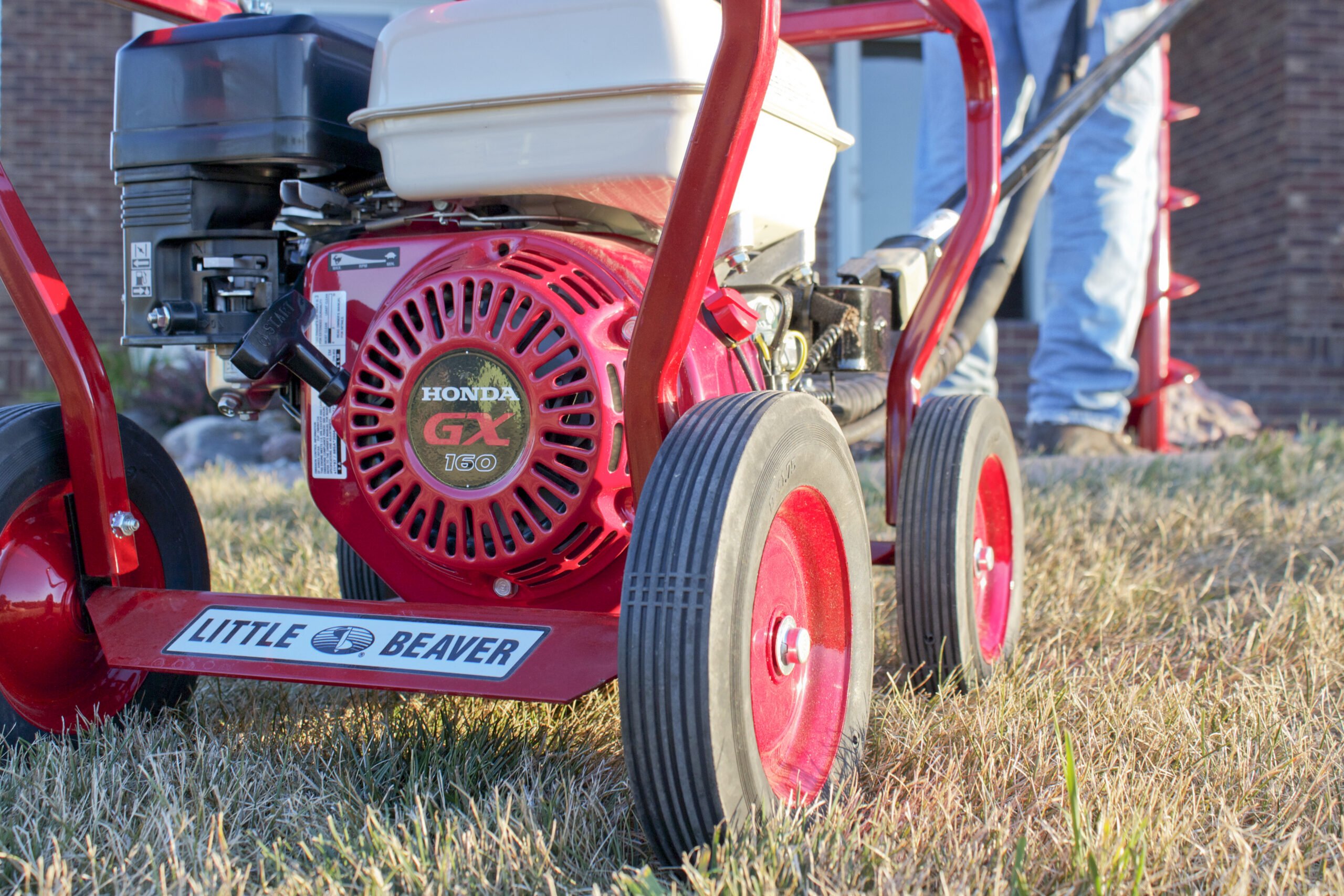
The mechanical earth drill offers high-speed auger rotation to dig holes quickly and cleanly. These models have engines ranging from 5.5 horsepower to 8 horsepower, providing ample power for nearly any project. The mechanical earth drills have a standard gear ratio of 10:1 with the option to purchase a 20:1 or 13:1 gear ratio for applications that require more power at a lower speed. The compact size of our mechanical earth drill makes it great for residential fencing, sign installation, landscaping and other limited access construction projects. With optional wet and dry horizontal boring kits, the mechanical drill allows you to take on even more projects such as boring under sidewalks or driveways.
The hydraulic earth drill offers rugged durability for challenging soils and applications. With engines ranging from 10.7 horsepower to 21.5 horsepower, Little Beaver hydraulic models offer ample power for drilling through heavy clay or rocky soils. We recommend the hydraulic earth drill for industrial fencing, foundation pier holes and groundwater monitoring. The hydraulic drill features an optional anchoring kit to install mobile home and utility anchors quickly and efficiently.
Maneuverability
Our mechanical and hydraulic earth drills come with two different engine carriage options so you can choose the best way to move your drill through the jobsite. The standard option is the rolling wheel carriage that features semi-pneumatic or pneumatic tires with the optional addition of a roll cage.
For additional maneuverability, you can upgrade to a specially designed rick-sha carrier that features 20-inch semi-pneumatic wheels for navigating over rough terrain. A convenient pull handle and transmission cradle make it easy to smoothly move the earth drill to your exact drilling location.
Drilling Handle
Both the mechanical and hydraulic earth drills feature our innovative torque tube. This tube redirects the torque away from the drill by transferring kickback from the auger to the power source. Most drills without torque protection require two operators. However, because our earth drills come with the torque tube, the standard handle on our drills is the one-man handle.
Our hydraulic drills offer additional handle options: a two-man handle for drilling holes that are larger in diameter or extra deep, and the high-torque anchor handle for anchoring mobile homes or light utility work.
Work with a Pro
There are many factors to keep in mind when choosing your earth drill and the features that best fit your application. The good news is that Little Beaver staff is here to help. We have more than 60 years of experience in the earth drill manufacturing business, and we are qualified to help you choose the best drilling equipment for your project. Call us today to get started.
Last updated Mar 27, 2026
Using an Earth Drill to Install a Mailbox Post
If you’re wondering how to install a mailbox post, you’re not alone. Mailbox installation is a very common do-it-yourself (DIY) project many homeowners take on. For the least labor-intensive option, we suggest renting an earth drill to get the job done. Using an earth drill, like Little Beaver’s mechanical or hydraulic earth drill, will not only be more efficient than alternative methods, it will also reduce the strain on your back and other potential injuries.
What You’ll Need:
- Little Beaver earth drill with an auger 3 times
wider than the post - Mailbox post (we suggest a 4×4-inch wooden post or
two-inch diameter steel or aluminum pipe) - 50-pound bag of concrete
- Mailbox
- Bricks or stone for landscaping (optional)
After gathering the necessary items, we suggest starting by calling 811 to mark buried utilities and checking the manufacturer instructions that came with your mailbox model. Once you have your Little Beaver earth drill rental, make sure to read the owner’s manual or work with your rental center to learn how to operate the drill. Once you’re ready to go, watch our easy set-up video to see the step-by-step process for setting up the drill and disassembling it for transportation. You can also contact the Little Beaver team with any questions!
Per USPS guidelines, a mailbox should be placed six to eight inches back from the curb and 42 inches off the ground. Once you’ve found the right spot, you can start a pilot hole using the earth auger. This is a small hole drilled into the ground to help guide the larger drill for a more precise drilling location. Once the pilot hole has been created, it’s time to put the earth auger to work! After you’ve drilled to your desired depth, typically 20-24 inches, simply lift the auger from the hole and you’re ready for the next step!
Although it’s possible to install a mailbox without concrete, we suggest taking this extra step for improved security and durability. After preparing a bag of fast-setting concrete, place the post in the hole and pour the concrete into the hole around the post. Make sure to allow a few inches of space at the top of the hole and use a level to double-check that the pole is straight. If it has shifted, adjust quickly before the concrete dries.
After the concrete has set, it’s time to attach the mailbox to your post! Most manufacturers have their own instructions for how to get this done, so we recommend following those closely. Once the mailbox has been attached, don’t forget to add your address. If your mailbox is on a different street than your home, USPS requires that you put the full street address on the mailbox.
Even though your mailbox is technically complete after adding your address, you can always go a step further by landscaping around the mailbox before returning your earth drill to the rental center. Earth drills have many uses, including DIY landscaping such as planting small shrubs around your mailbox post.
Last updated Mar 27, 2026
Using an Earth Drill to Successfully Install Wooden Fence Posts
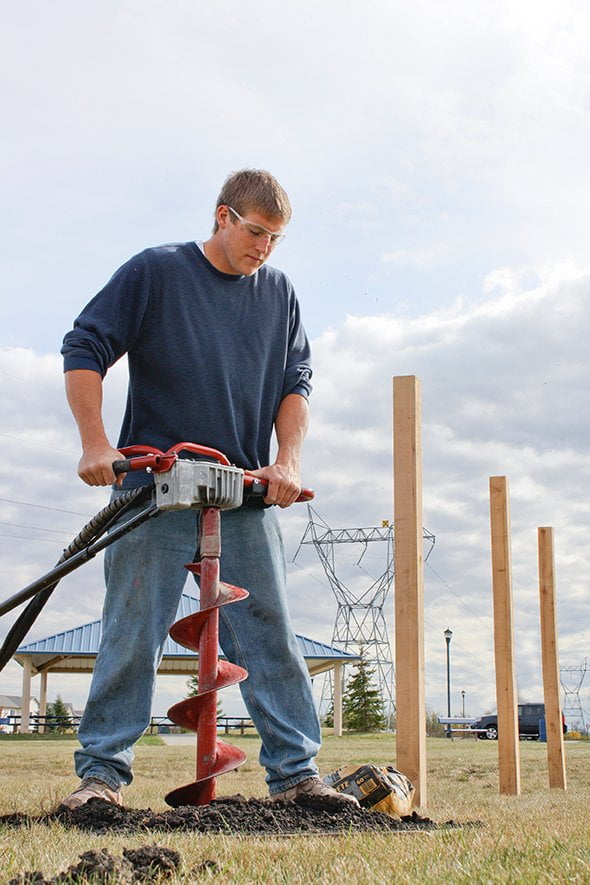
Installing wooden fence posts can be a great DIY project, especially if you’re renting an earth drill to make the job more efficient and less labor-intensive. Before you get started with your fencing project, there are a few things to know to set yourself up for success and prevent frustration in the future.
Plan Ahead
As tempting as it might be to start drilling as soon as possible, it’s important to call 811 and check local codes and ordinances before you drill. 811 is the national call-before-you-dig phone number that will send out a locator who will mark the approximate location of any buried utilities with paint or flags so you can avoid them. Some areas will also require permits before you build your fence, so make sure not to skip this step.
What You’ll Need:
- Shovel
- Gravel
- Level
- Concrete mix
- Mechanical earth drill with an auger 3 times wider than the posts
- Stakes (enough for each wood post)
- Wood posts (at least 8 feet in length)
- Rope (the length you’re setting your fence posts apart)
Lay the Foundation
The type of wood you choose for your fence posts will determine their life expectancy. It’s also important to look for chromated copper arsenate (CCA) pressure-treated wood, which will slow the decay of wooden fence posts over time. Pine is a popular choice for fences that can last up to 30 years when treated. Other long-lasting woods are redwood, sweetgum or cedar because they are highly resistant to moisture which helps prevent decay, cracking or warping.
Once you have the supplies you’ll need, carefully mark the location of each post with a temporary stake. When building wooden fences, it’s crucial to have the fence posts in a straight line, otherwise you’ll notice the poles weaving in and out of line after the poles have been placed. Stretch a long rope between each stake for a simple way to measure and mark the location of each post.
After you have marked the location of each post, it’s best to use a shovel to remove any sod you might be drilling through. Grass and vegetation can clog the end of an auger — especially when wet. This step might seem like a hassle at first, but it will save you time and frustration once you start drilling.
When it comes to picking a drill to rent, we suggest prioritizing safety. All Little Beaver earth drills incorporate torque tubes along with a slip clutch for added safety while drilling. A torque tube offers consistent safety by absorbing shock as you encounter different soil and resistance. On the other hand, the slip clutch offers protection for both the operator and the drill if you hit a rock or tree root while drilling.
Get Drilling
When the prep work has been finished, it’s time to get drilling. Make sure the auger enters the soil perpendicular to the precise point you marked with the stake and keep it vertical as you drill. It’s important to prevent the auger from entering the ground at an angle; otherwise, you risk setting a crooked fence post or a creating hole that’s difficult to backfill.
Dig the fence post hole so the diameter is 3 times the width of the post. For example, if the fence post has a 3-inch diameter, the hole should be about 9 inches wide. The depth of the hole should be one-third to one-half the post height above ground. For example, if the fence post is 9 feet tall, the hole depth should be at least 3 feet. If you live in a cold climate, it’s also important to make sure you dig your post below the frost line to prevent the fence posts from moving or heaving when the ground freezes in the winter. To dig below the frost line, check the local frost lines in your area and dig your hole 6-inches below that.
When the hole is complete, make sure to stop the auger and pull it out for a clean hole. To make this step easier than ever, Little Beaver mechanical earth drills have a lightweight design and our hydraulic earth drills feature a reverse button. Continue the drilling process until all fence post holes are complete.
Set the Posts
When all the holes are drilled, pour in about 3 to 4 inches of gravel. This will help with drainage as opposed to a post hole that’s filled entirely with concrete. Use a piece of scrap lumber or other blunt object to tamp down the gravel. This will ensure it doesn’t settle and allows for optimal drainage. On top of the gravel, add about 6 to 8 inches of concrete, and place your post in the middle of the mixture. Using a level right after this step will help to make sure the post is properly positioned. Once the concrete is leveled, fill the rest of the hole by backfilling the dirt and tamping as you go. From here, follow the instructions on your concrete mix to see how long it will take to dry.
After this step, your fence posts are ready to go, and the rest of your fence can be assembled. If you have any questions regarding drilling holes for fence posts with a Little Beaver earth drill, don’t hesitate to contact the Little Beaver team. We’re happy to help with any questions that might come up.
