Last updated Sep 30, 2026
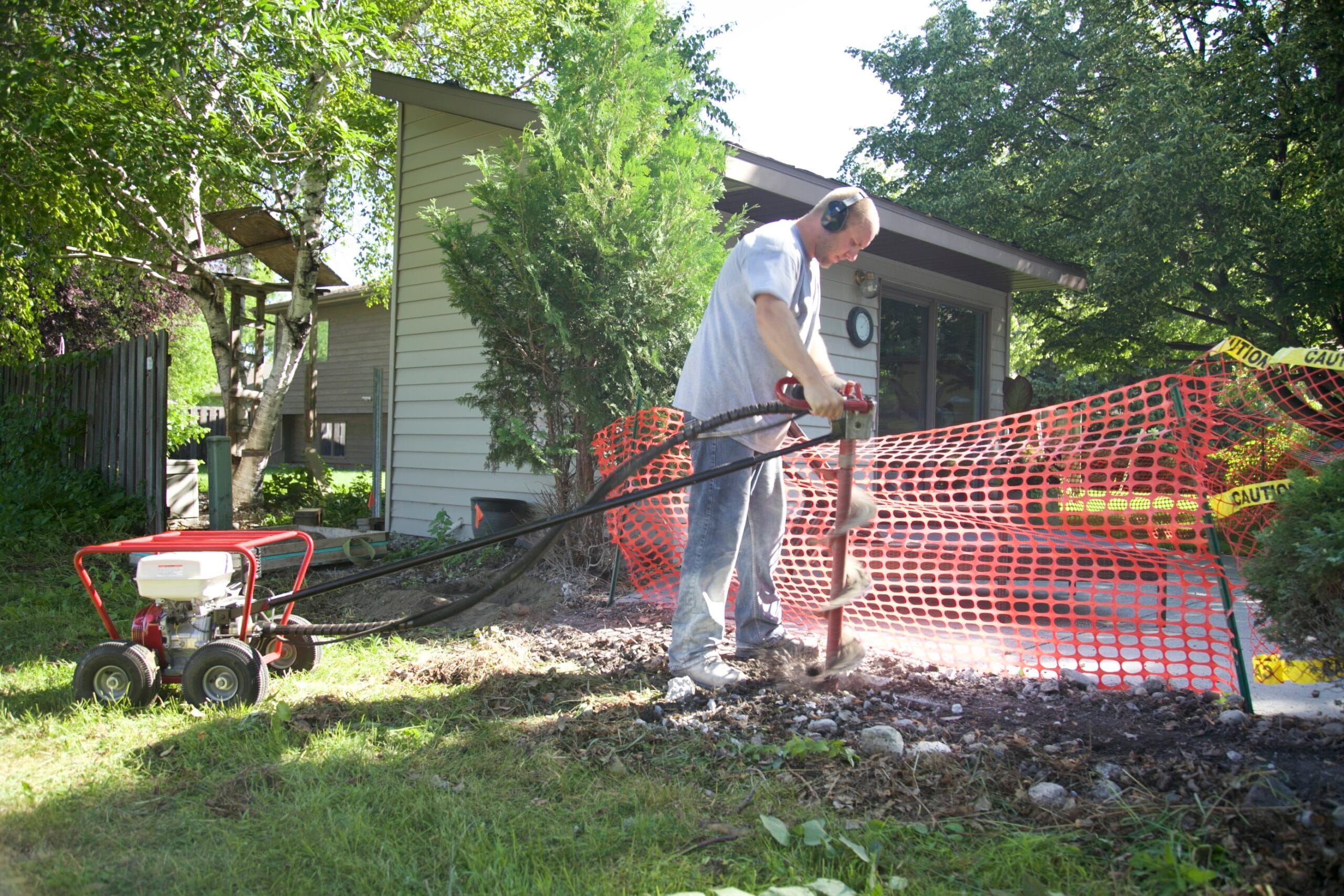
Modern residential lots have small yards, narrow gates and limited access, which makes confined access earth drills essential for landscaping tasks. Whether you’re using these drills for fence post installation, tree planting or deck footings, choosing the best earth drill for a tight space makes the work safer and more efficient. So, how do you select drilling equipment for backyard access? Here are a few considerations to keep in mind:
1. Choosing the Right Size Earth Drill for Limited Access
Backyard gates are often between 36 and 48 inches wide, which makes it difficult to transport a skid steer or other compact tool carrier into these areas. Landscaping features can further reduce maneuverability in a yard. Often, machines that are too large to fit through a fence gate are also too heavy or too disruptive to the lawn or turf to make for a good drilling option.
Our Mechanical and Hydraulic Earth Drills can take on everything from soft soil to dense, rocky soil applications for drilling small- to medium-diameter holes between 1.5 to 16 inches. They weigh between 145 and 325 pounds with a width up to 33 inches, able to fit through standard fence gates. The Mechanical drill’s high auger speeds — up to 360 rpm — make for fast project completion while the lightweight design maximizes mobility in tight spaces with narrow gates.
2. Considering Safety Features for Tight-Space Earth Drilling
Safety features are critical to protect operators and improve productivity. Compact earth drills often rely on two operators to protect against kickback when the auger hits an obstacle, but this means that contractors or homeowners need two people to dig. This might not be ideal when the earth drill needs to get into a tight spot where multiple people might not fit.
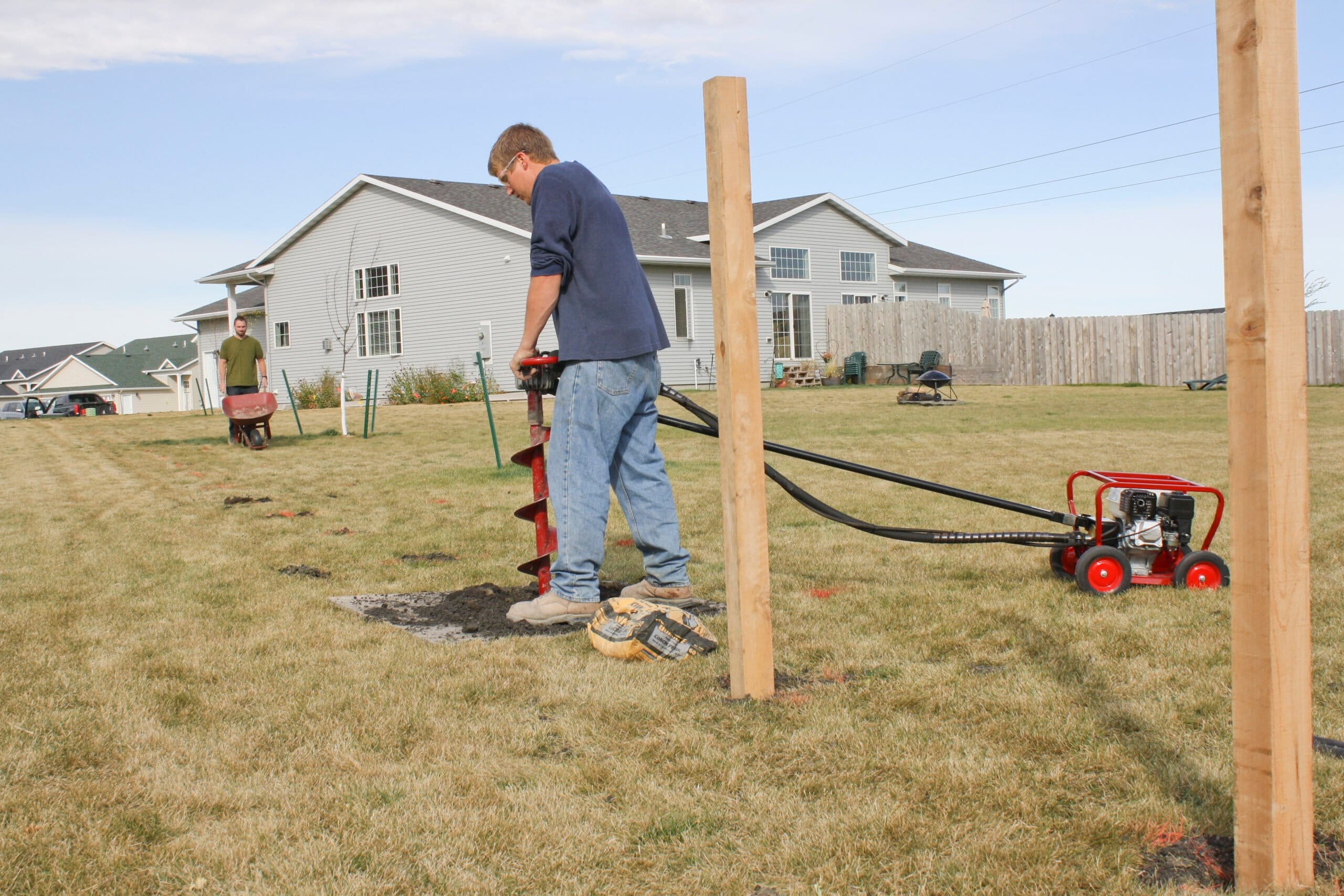
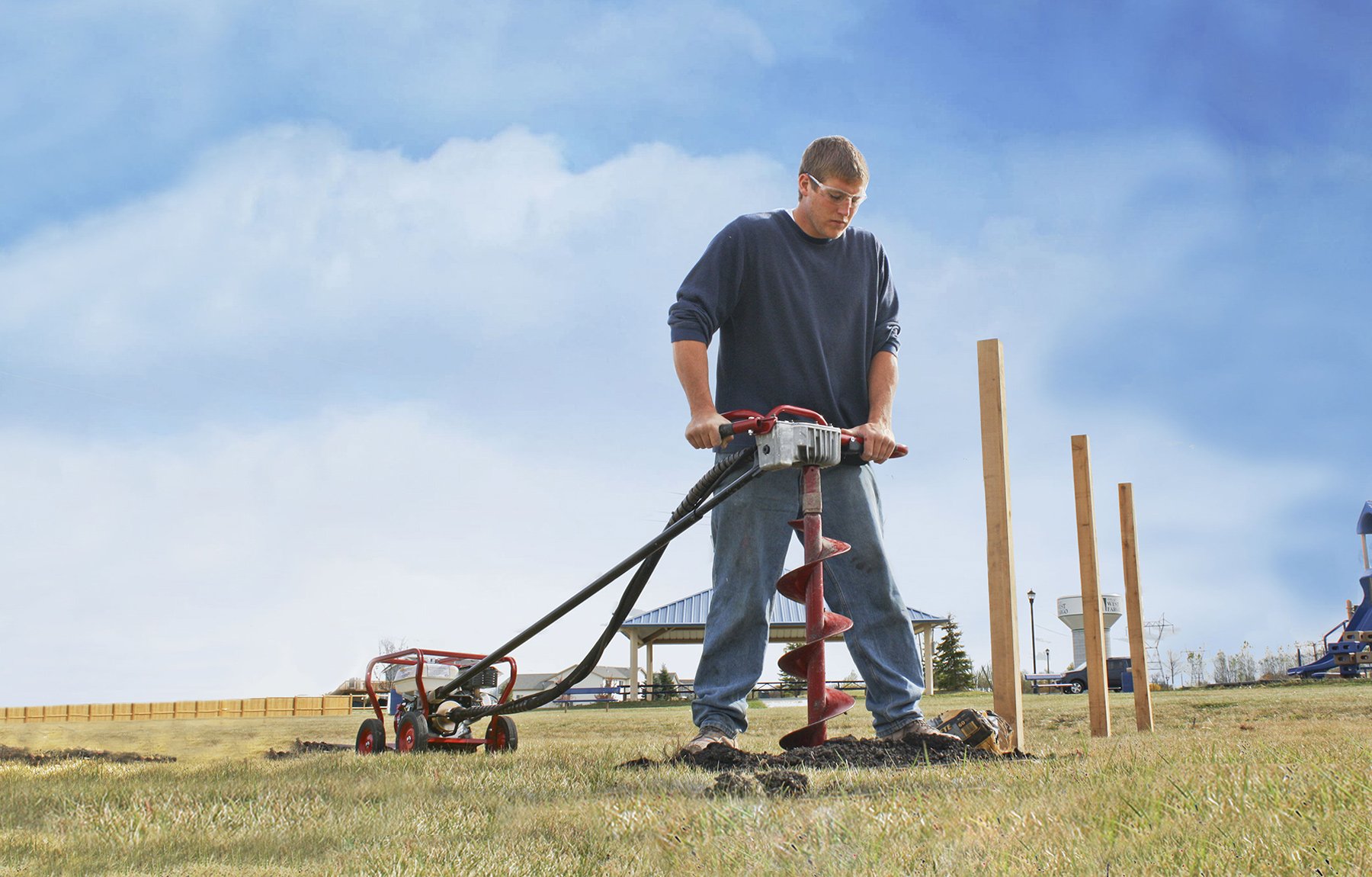
One way to get around needing two operators is to make sure that the drill you’re considering has a torque tube. A torque tube directs kickback away from the operator, along the torque bar to the engine carriage. This design makes the drill safe and efficient for one-man drilling, reducing the space needed to drill next to a wall, in small yards or near existing structures.
3. Picking an Earth Drill for Different Soil Conditions
In narrow spaces, you might not have a lot of options in terms of the makeup of the soil where you’re digging. Contractors and homeowners might default to larger equipment in these instances, assuming that bigger equipment will cut through harder soils more easily. However, that isn’t always true.
Roughly 80% of projects can be completed with standard augers and standard points and blades, which work best in loamy, sandy soil. If there’s rocky soil where you’re drilling a posthole, it’s best to have a variety of options for the drill’s augers, points and blades. Augers, points and blades help match your earth drill to the conditions to maximize drilling efficiency in different soil types.
Tougher ground requires more specialized equipment. Use a carbide blade with a rugged auger for clay and hard rock formations instead of a skid-steer mounted auger attachment. Heavy-duty augers also feature larger flighting and tougher cutting blades with optional heavy-duty points and blades for harder ground.
Small yards and narrow access points make larger compact equipment impractical for drilling projects. Look for a portable earth drill that operates safely and efficiently in tight spaces, allowing precision that can’t be matched with skid steer or compact loader attachments. To learn more about our limited access earth drilling solutions for backyard projects like fence post installation, deck footings or landscaping, contact our experts today.
Quick Specs to look for in Earth Drills for Tight Spaces:
- Minimum gate clearance: 36 inches
- Maximum digging depth: 36 inches
- Auger diameter: 1.5-16 inches
Last updated Sep 28, 2026
Contractors and homeowners have a variety of options when it comes to tools for post hole digging. Earth drills are often the equipment of choice, but they aren’t all made equal, nor will a single solution handle every possible variable. Safety features are a key consideration, but so are project scope and soil conditions. Here is a guide on how to pick the right drill for safe and smooth project completion.
One-man vs. two-man auger for digging post holes
Are you looking for an easy, safe way to complete your post hole drilling project with minimal manpower? Many augers require two operators for safety and ease of use because they are built in a way that sends kickback directly to the operator. However, most people prefer a one-man earth drill. For homeowners, who often rent the equipment, single-person operation is much more convenient for that DIY landscaping project or mailbox post installation. Contractors, on the other hand, can use their crews more efficiently by reducing the number of operators required for a single piece of equipment.
For drill selection, though, the real question is which is safer: A one-man earth drill or a two-man auger? Little Beaver Mechanical and Hydraulic Earth Drills address a key danger of drilling — kickback — with a torque tube. This innovative feature connects the auger to the engine carriage with a steel pipe that redirects the kickback to the engine carriage. If the drill strikes a rock, root or other underground object, the torque tube will absorb the force instead of the operator, making it easier for one person to control the drill. This makes one-man drilling a safer reality for a variety of post-hole digging projects.
Lightweight, compact drills for fenceposts
Another key factor for choosing the best earth drill for post hole digging is the size and quantity of holes that the project requires. Many fence installers prefer our Mechanical Earth Drill with its capability of drilling up to 360 rpm. Not only is this highly efficient for drilling multiple post holes, the high auger rotation also clears loose dirt from the post hole to speed up installation.
Mechanical Earth Drills are ideal for small- to medium-diameter post holes while Hydraulic Earth Drills are geared toward higher-powered drilling and digging large holes. The Hydraulic Earth Drills operate at a lower speed than Mechanical Earth Drills, but the additional torque increases efficiency for heavier-duty projects.
Earth drill options for tough soil conditions
The type of soil you are drilling in is also a critical consideration. We typically recommend the Mechanical Earth Drill for loose, sandy or loamy soils. But when you are working with rocky soil or dense soil like clay, Hydraulic Earth Drills, including our Towable Earth Drills and UN-Towable Earth Drills, provide the additional torque you need.
It’s also important to select the proper augers, points and blades to match the soil conditions. This will maximize your earth drill’s capabilities in the project environment, whether you are using a mechanical or hydraulic drill.
Choosing the right earth drill for post hole digging
To make sure you’re getting the right drill for your post hole drilling project, consider this checklist:
- Do I want a one-man or two-man auger?
- What soil am I drilling in?
- Should I use a mechanical or hydraulic earth drill?
- What size and quantity of post holes does my project require?
- What auger best suits my needs?
Post hole digging efficiency with earth drills
Getting the right post hole digging auger is easier when you know what factors to consider. Contact our team to discuss your post hole drilling needs. We can help you determine the best earth drill and accessories based on your project and operational requirements.
Last updated Mar 27, 2026
Equipment for Unique Fence Installation Jobs
Little Beaver is known in fencing circles for fast and efficient posthole diggers, like our Mechanical and Hydraulic Earth Drills. But our equipment’s capabilities don’t stop there. We know that your projects can vary and expand beyond setting traditional fences — like installing a dog fence or shallow electrical lines that run along a fence. That’s why we offer multiple equipment options for fencing, landscaping and more.
Here’s how our equipment can help streamline your projects:
Underground Fencing
Some fencing projects, like pet fencing, involve digging underground lines around the perimeter of a yard. Digging by hand makes the project longer and harder to complete. But what other option do you have?
Well, there’s our Kwik-Trench mini trencher. We offer two options: the KT 200B and the KT 2400B. The KT 200B is built for lighter-duty jobs and smaller yards while the KT 2400B is for more demanding applications in tougher soils. Here are the overall benefits of both options:
- Minimal turf disturbance
- Trenching speed up to 30 feet per minute
- Trench depth range of 6-12 inches
- Compact with a practical cutter wheel design
- Maneuverable for tight spaces
The Kwik-Trench offers a safe, easy way to dig a uniform trench with consistent depth and size. For fencing contractors, a mini trencher saves hours of hand digging, significantly speeding up trenching tasks. It also creates the opportunity to support other projects, like installing electrical lines for landscape lighting.
Crossing Under Obstacles
Sometimes, underground fencing and electrical lines need to go underneath an obstacle, such as a sidewalk or a driveway. This task traditionally requires manual tunneling or cutting through the concrete to the ground below. Both of these options are time consuming, and breaking through the concrete diminishes the strength of the entire slab.
If you’re already using our Mechanical Earth Drill for fence installation, or if you’re considering adding one to your fleet, remember that it can be more than just a posthole digger. Our Horizontal Boring Kits pair with your Little Beaver Mechanical Earth Drill and bore cleanly underneath obstacles without disturbing the surface. There are two kits to choose from: a sidewalk boring kit and a driveway boring kit.
The sidewalk boring kit is a dry boring solution that’s perfect for smaller spans like those underneath sidewalks and includes a 5-foot auger with a 3-inch diameter bit and a 5-foot extension with a universal wiggle joint. The driveway boring kit is a wet boring solution and bores up to 50 feet underneath driveways or parking lots. The kit includes the option of a 2-, 3- or 4-inch drill bit as well as a swivel adapter, swivel assembly and horizontal boring key. To complete the kit, operators will need to use a garden hose, 3/4-inch Schedule 80 water pipe and 3/4-inch pipe collar. Both kits connect to our Mechanical Earth Drill.
Expand Your Capabilities
An earth drill isn’t the only piece of equipment from our line that can help optimize your projects. Once you’ve invested in an earth drill, you can expand outward with other solutions to boost your productivity and expand your capabilities. Contact our experts today to learn more about how our equipment can be used for fencing and landscaping.
Last updated Mar 27, 2026
There’s a lot of math involved in running a fencing company. Calculating the time required to complete a job, the number of crew members that will be needed on site, how many jobs the operation can take on and the cost of materials is just the beginning to ensure the business will be profitable. Every opportunity to reduce the time spent on the installation process and maximize resources on the jobsite has a direct impact on the bottom line.
A significant line item in any fencing operation’s calculation is its equipment cost. Most residential fence installers invest in an earth drill to speed up the posthole digging process.
This key piece of equipment has a big impact on a fencing crew’s productivity, and, with the right features, this expense can lead to a big boost in the bottom line.
One is Less Than Two
There are many portable earth drill options on the market, but most require two-man operation for safety. When an earth drill hits an obstacle underground, it can jerk and jar the operator with enough force to result in injury. Because this is so dangerous, most drills require two operators to hold the drill steady and combat these effects. However, Little Beaver’s torque tube makes one-man drilling possible with both our Mechanical and Hydraulic Earth Drills by redirecting kickback to the engine carriage as opposed to the handles.
When you can subtract one operator from the drilling process, the labor cost for that step is cut in half. Multiply that by dozens of postholes for a single fencing job and the savings add up. The second crew member can be reassigned elsewhere, such as following behind and placing the fence posts, to optimize the workforce on the jobsite.
Double Drilling Speed
Ready for more math? One of the key advantages of our Mechanical Earth Drill is its operational speed — the auger can rotate at up to 360 RPM. Most other drills can’t meet this speed in a one-man drilling package and it’s common to see competitive drills operating at half that pace.
The Mechanical Earth Drill can create a posthole in less than one minute, cutting down on drilling time and speeding up the installation process. The fast rotation speed also creates a smoother, cleaner hole than other posthole digging options, reducing time required to prepare the hole for the fence post. By cutting back on time spent digging, contractors can complete more projects in less time, bringing additional income into the equation.
Do The Math
The common denominator leading to one-man drilling and increased drilling speed is Little Beaver’s Mechanical Earth Drill. With reduced labor requirements and improved safety features, our earth drills provide both short- and long-term financial benefits.
Calculate your potential savings! Learn more about how Little Beaver earth drills can increase fencing revenue with faster drilling today.
Last updated Mar 30, 2026
Fences keep children and pets inside your yard while keeping intruders or unwanted critters out. They can also be useful for privacy and noise reduction. Once you’ve decided that you want to build a fence, the biggest question is: do you hire a contractor or do the work yourself?
Do it Yourself, with the Right Equipment
If you choose to install a fence yourself, make sure you have more than enough time to work on it. There’s bound to be unexpected obstacles, so project completion will likely take longer than anticipated. You’ll also need to familiarize yourself with any local zoning ordinances that regulate fencing.
If you go your own way, see if you can find a neighbor, friend or relative who has completed a similar job so you can lean on them for advice and maybe a helping hand. For any DIY fencing project, it is imperative that you call 811 to have underground utilities marked. This will minimize your liability and help keep you safe from dangerous digging accidents.
Fencing is hard work, but it’s easier when you have the right equipment. Little Beaver earth drills are versatile, and you may want to consider buying one if you anticipate more projects, such as running wires under your sidewalk for lighting, running pipe under your driveway for irrigation, planting a garden or installing drain tile. But if you only foresee needing an earth drill for this single task, there are rental centers nationwide that offer our equipment.
Mechanical earth drills are the most popular choice among fencing contractors, as they offer swift speed and light weight. This model is ideal for sandy or loamy soils with few obstructions.
Hydraulic earth drills are best for areas with exceptionally rocky sediment or hard clay. Little Beaver Towable Earth Drills can be a convenient option for pulling the equipment right up to your work area, while our UN-Towable Earth Drills can be stowed in the back of a pick-up truck or SUV. Both are hydraulic.
Mechanical and Hydraulic Earth Drills speed up the fencing process as they can drill a hole in less than one minute with minimal effort. Our models also make drilling safer for one person. Little Beaver’s steel torque tube protects the operator from dangerous kickback by transferring that kickback from the auger to the power source.
Hire a Contractor
Naturally, contractors know where to find the highest quality materials, so you’re more likely to get a top-notch product in that regard. Their many years of experience equip them to handle difficult scenarios with ease. Is the area you seek to fence flat or hilly with a steep terrace? This may be difficult to navigate on your own.
Ask yourself if this fence is a temporary fix or a structure that you hope will last for many years to come. An error made during a DIY installation might compromise the integrity of the rest of the fence. Given their level of experience, a contractor is more likely to get it right the first time. If the fence will be especially large or one that requires going deep underground, you might be better off hiring a professional. Read online reviews and seek recommendations from friends to ensure you hire someone who is safe and reliable.
Fencing Finale
There are many factors to consider when deciding between DIY and hiring a contractor for your fencing project: your time, budget and handyman abilities. If you do the work yourself, Little Beaver Earth Drills will help you achieve your project goals effectively. We also have a vast library of informative blogs on our website to help guide you through the process and answer any questions you might have. If you have questions, contact us directly by phone or email.
Last updated Mar 27, 2026
Utilizing a Mini-Trencher to Bury Dog Fence Wire
Wired electric dog fences are growing in popularity as a way to safely contain your dog without the hassle of installing a traditional fence. In addition to increasing curb appeal, electric dog fences work well for odd-shaped yards, create a stronger signal than wireless fences and can be easily expanded with the addition of more wire.
When it comes to installing electric dog fence wire, there are a variety of ways to do it. Instead of straining your back with manual installation methods, we recommend renting a mini-trencher like the Kwik-Trench to get the job done. Here are the steps to complete the work as easily as possible.
What You’ll Need:
- Dog fence containment system
- Kwik-Trench mini trencher
- Twisted wire
- Wire cutters
- An electric drill (optional)
- Splicing kits
- Shovel
Establish the Boundaries
Once you have everything you need, plan the boundary for your dog. Whether that’s sectioning out a dog-free area or laying boundaries in a large yard, it’s important to plan just how much access to give your dog. Make sure to check the manual that came with your electric dog fence during this step for any restrictions or local guidelines.
You’ll need to make note of a few areas to consider while establishing this boundary. The first is to find an electrical outlet where the transmitter box will be located. Many homeowners choose their garage or shed. The other area to mark is where you want your dog to be able to cross the wire safely, such as through doorways.
Create Crossing Points
To create points where your dog can cross safely, use a pair of wire cutters to snip the wire in the location you need. Make sure to also disconnect the wire from the transmitter box by removing the pin of wire. Then, take some twisted wire and twist it together with the dog fence wire so there is around one twist per inch of wire. A good rule of thumb is the more rotations the better. If you’re hoping to create a lot of cross points for your dog, using an electric drill for this step can make things easier.
Once the cross points have been twisted, splice the twisted wire and place it back inside the boundary loop. We suggest a splicer kit for this step to make the process easier. Then, connect the twisted wire to the transmitter box.
Time to Trench
It’s worth noting that some will try to staple the electric wire above ground for an easy solution, but this will shorten the lifespan of the wire when rodents, the dog or weather degrade the wire. It can also pose a tripping hazard or get caught in lawnmowers. A better solution is digging a trench to bury the wire, and renting a mini-trencher is both easier and more efficient than manual methods. Dog fence wire should be buried 3 to 5 inches below the ground. This is deep enough to protect the wire from animals and weather but shallow enough to maintain a strong signal.
To get started with a mini trencher like the Kwik-Trench, watch this helpful video for how to operate the machine. As the trencher is warming up, make sure to lock the swivel wheel to trench straight lines. Once the swivel lock is in place and the trencher is warmed up, use the manual crank control to adjust the cutting depth and simply push the trencher forward. With a mini-trencher like the Kwik-Trench, you can dig up to 30-feet of trench per minute. If your trench needs to follow curved lines in some areas, simply unlock the swivel wheel to easily move around small yards or hard-to-access areas.
Backfill it Up
Once the trench has been dug, place your dog fence wire inside and get ready to backfill. When using a Kwik-Trench, backfilling is easier than ever because the machine neatly deposits the soil right next to the trench so you can simply push it back in with a shovel. An added benefit of using a Kwik-Trench for burying dog fence wire is the pneumatic tires that won’t damage turf. This means after backfilling your trench, your job is complete – no additional clean-up necessary!
If you have any additional questions about how to dig a trench for an electric dog fence, don’t hesitate to reach out to your local rental center or a Little Beaver expert. We are happy to help make your project go as smoothly as possible!