
Last updated Mar 27, 2026
Tips for getting the most out of your Kwik-Trench
Whether you have owned a Kwik-Trench for years or you’re renting one for the first time, there are a few dos and don’ts that are important to know beyond the guidelines for basic operation. From safety precautions to backfilling advice, we put together a list of tips to keep in mind for your next project.
1. Do Select the Right Trencher for the Job
If you’re wondering how to choose the right trencher, you’re not alone. With so many options available, it’s helpful to narrow down your search using important criteria such as the size of the project, the soil type and how deep and wide you’ll be trenching.
Mini trenchers like the Kwik-Trench can cut up to 30 feet per minute and dig up to 12 inches deep, making them an excellent choice for the shallow trenching needs of rental stores, landscape contractors, golf courses and more. The Kwik-Trench not only has a compact size that can get to places larger trenchers can’t, its pneumatic tires also help to preserve your lawn. With the ability to easily saw through a variety of tough materials like compacted clay, road fill, asphalt and tree roots up to 10 inches thick, the Kwik-Trench is a great choice for almost any landscape project.
2. Don’t Forget to Call Before you Dig
Making sure to call 811 at least three business days before starting your project is a crucial step when it comes to safety and preventing damage to underground utilities. This free service, available in the United States and Canada, sends professionals to your property to mark the location of underground utility lines including water, power and gas so you can know where to dig and what to avoid.
3. Do Plan Your Path
Another helpful tip is to use marking paint to map the path for your trench after the utilities are marked. This is an easy way to save time and be sure you stay on track. Complete a visual assessment to understand the soil you will be digging through and to check for any obstacles, such as tree roots, that you might encounter along the way. When preparing to trench along a straight path, lock the rear swivel wheel of the Kwik-Trench into position to easily guide the trencher straight ahead.
4. Do Use a Proper Method for Backfilling
Properly backfilling a trench will prevent sinking and settling later. A Kwik-Trench simplifies the backfill process by creating narrower trenches and depositing the soil neatly on one side of the trench. This allows you to backfill 50% faster than models that deposit soil on both sides. Backfill 4 to 6 inches at a time, making sure the soil is level and free of debris. This will prevent the occurrence of cupping as the dirt settles.
5. Do Stop and Troubleshoot if Your Machine isn’t Working
If you notice your Kwik-Trench isn’t working properly, make sure to stop and check out the Kwik-Trench FAQ page to troubleshoot. For example, if the cutter wheel quits turning when you push forward, that usually means the clutch mechanism or drive belts are slipping. In very hard clay soils, you can prevent this problem by pushing slowly and letting the machine cut at a slower rate. If your machine binds when you try to raise or lower it, cleaning the guide tubes and lubricating with a graphite or silicon spray should do the trick. For Kwik-Trench owners, staying on top of routine maintenance is a good bet to ensure optimal performance.
At Little Beaver, we’re committed to your success no matter the size of your project. If you have additional questions regarding your Kwik-Trench, don’t hesitate to contact us or check out our FAQs.
Last updated Mar 27, 2026
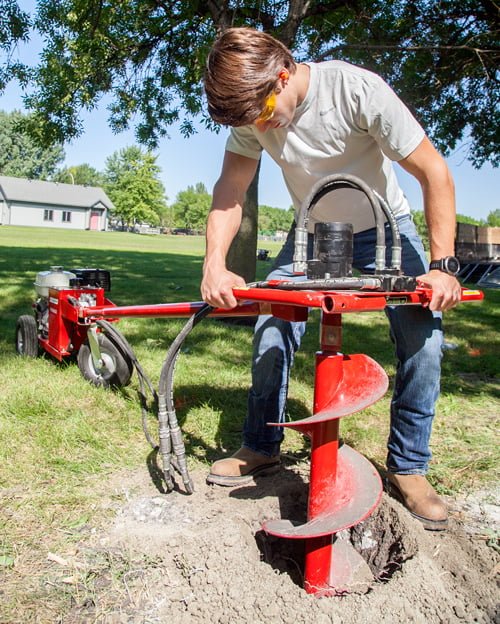
Solutions to common hydraulic drill troubleshooting questions
Using a hydraulic earth drill can make your projects easier than ever, which is why we want to do everything we can to make sure it’s operating in peak condition. Whether you feel like your hydraulic earth drill might be losing power or the starter rope is becoming difficult to pull, you’ll find the solutions to these questions and more right here.
Making the Starter Rope Easier to Pull
If it’s difficult to pull the starter rope on your hydraulic earth drill, check to make sure the quick disconnect couplings are fully engaged. Quick disconnect couplings provide fast and easy connection of fluid lines to easily start the drill. When they are not fully engaged, pulling the starter rope can be difficult.
The hoses can be easily connected without using tools. Connect the handle to the power source, attaching the return side first. This is the long hose that comes from the return line filter. Then, connect the pressure side of the handle to the power source.
Fixing Auger Turning Issues
When the auger turns fine in one direction but does not turn or turns very slowly in the other direction and stops when hitting the ground, your valve control linkage is most likely bent.
The valve control linkage is a small rod that connects the control to the valve spool. To fix this, straighten the linkage, making sure the flat part of the lever (the part you push or pull with your fingers) does not touch the handlebar at any time.
Improving Drill Power
If your hydraulic earth drill appears to have lost power, double check the oil that was used at the last service interval. Some retail or automotive stores sell multipurpose oils designed for tractors that are labeled “hydraulic oils.” These oils are not suitable for the Little Beaver power source because they have different additive packages. This can cause the hydraulic components to degrade faster and power to decrease due to friction and internal leakage. If you find that inappropriate oil was used, we suggest having your hydraulic drill checked by a reputable service dealer or calling us at 936-327-3121 and replacing the oil to avoid long term damage. It’s very important to always use the recommended grade when replacing hydraulic oil and to be sure to follow a schedule for regular oil changes.
If the troubleshooting solution you’re looking for isn’t listed here, take a deeper look into our service FAQs for hydraulic earth drills or check out the owner’s manual. If the answer to your problem still isn’t coming up, don’t despair! Contact us to speak with a member of our team for a personalized solution.
Last updated Mar 27, 2026
How to solve problems preventing your mechanical drill from working properly
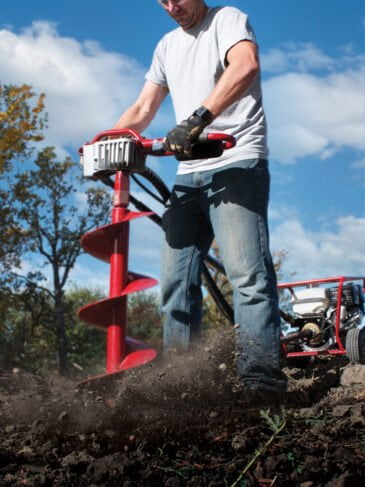
There’s nothing more frustrating than your mechanical earth drill not performing the way you want it to. For more than 50 years, Little Beaver earth drills have been the #1 choice of rental store owners, fencing contractors and other professionals who want a one-man auger that’s safe and simple to operate. We’re dedicated to your success and have an extensive list of FAQs to address operation and maintenance questions. Check out solutions to some of the most common questions we receive about operating our mechanical earth drills.
The Drill Doesn’t Start
If you’re having trouble starting your mechanical earth drill and you’ve checked the fuel levels, there are a couple things you can try to get it working properly.
We incorporate an engine kill switch on the operating handles to allow quick fingertip control of the shut off for both safety and convenience. Often overlooked, this switch can be the culprit and an easy fix to a drill that will not start. There is also a switch incorporated in the torque tube bracket that will prevent the unit from running unless the torque tube is installed. This switch provides added safety and operator protection.
If the switch isn’t the culprit, take a moment to inspect your spark plugs. Clear indications that the spark plugs need to be changed include an engine that misfires, surges or consumes significant fuel. While you’re at it, we also recommend checking the engine oil. Although the engine has an alert that prevents operation when levels are too low, proactively checking the levels can save time and avoid hassle in the future.
Getting an Auger “Unstuck”
Occasionally, when drilling, you may encounter soils or circumstances that prove challenging for even the most powerful drills. If your auger is stuck in the ground, disconnect the handle/gearbox. Then use a pipe wrench on top of the auger to turn it in a counter clockwise direction. Be very careful not to damage the auger top.
If the pipe wrench is not successful, we do offer a specially designed tool for this situation. Part #9022-T is a Tee Handle. This handle is used in place of the pipe wrench for added leverage. You can order a Tee Handle by calling 936-327-3121.
To prevent this situation in the future, make sure not to push down on the auger when digging in soft clay or sandy soil. Let the drill do the work to efficiently cut its way through the soil.
Getting the Auger to Turn When the Engine is On
If your engine runs but the auger doesn’t turn, a problem with the drive train is the most likely situation. Frequently, the issue can be traced back to the flexible shaft core. The best way to determine if the flex shaft is the issue is to inspect the core end fittings for cracks or breakage. If the flex shaft core appears to be undamaged, check the key on the clutch drum, the gears or shaft keys within the gearbox and the adapter key on the gearbox output shaft for signs of damage.
If you find damage to the flex shaft or an issue with the gearbox, get in touch with our team to get the necessary repair parts and tips on how to prevent future damage. If both look fine but the auger still doesn’t turn, contact us or check your maintenance manual for further information on this issue.
Keeping the Auger Still When Not Engaged
If your auger turns all the time – even when not engaged – try adjusting the engine idle. If you’re unable to adjust to a low enough level to prevent turning when not engaged, replace the springs on your centrifugal clutch. To get the replacement springs and any tips on how to install them, contact us at 936-327-3121.
When an auger is working properly, the springs in the centrifugal clutch adjust when the auger is engaged so the clutch shoes push back and forth against the clutch housing to propel the auger. When not engaged, the clutch shoes stay still, so the auger stops turning. As the springs wear down, they loosen so the clutch shoes always pulse against the clutch housing.
To help reduce wear on the springs, make sure not to “bog down” the engine when using the drill. It’s important to let the auger turn fast enough that the clutch doesn’t slip because excessive slippage will cause overheating and loss of temper of the springs.
If you’re still not finding what you’re looking for, take a deeper look into our service FAQs for mechanical earth drills or check out our owner’s manual. If the answer to your problem still isn’t coming up, don’t despair! Contact us to speak with a member of our team for a personalized solution.
Last updated Mar 27, 2026
How Little Beaver Earth Drills bring versatility and efficiency to municipalities
Municipalities have their work cut out for them. Whether it’s city maintenance workers or general contractors hired to sustain parks in a city, town or borough, a day’s work can involve several industries’ skills rolled into one crew. They can be installing fence posts in the morning, replacing sprinkler lines mid-day and find themselves planting trees in the afternoon.
With this much variety, working smarter, not harder, is paramount to overall productivity. And having versatile tools that allow crews to better utilize labor, safely, while also outperforming other methods, can have a major impact on efficiency. Little Beaver Earth Drills can do just that. Our full line of earth drills enables safe one-man operation with nearly two times the productivity of other units. It’s just a matter of finding the Little Beaver earth drill that best meets your municipality’s needs.
Here are our two most popular earth drills for municipalities and how they can streamline work for grounds crews.
Mechanical Drills + Boring
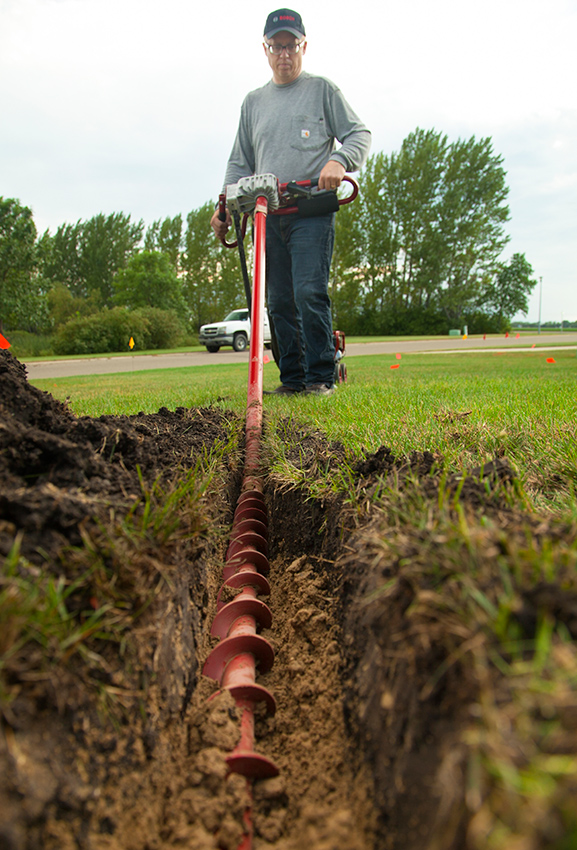
If your town or city plants a lot of small greenery, installs several fences or other tasks that require crews to dig numerous footings quickly throughout the year, our Mechanical Earth Drills may be right for you. Perfect for horizontal boring or fast, narrow hole drilling, these drills, like all our drills, allow for safe, one-man operation and have the speed to help crews excel.
With our mechanical drills, users can choose from augers ranging from 1.5 to 16 inches in diameter with 36- or 42-inch lengths. And with multiple gear reduction ratio options, crews can choose a mechanical drill with 360 RPM for loose, soft soils or one with a lower speed that is better suited for dense, rockier formations. With a mechanical drill, crews can quickly install a long row of shrubs and then shift to setting a pole for a basketball hoop in denser soil — all without missing a beat.
To further increase municipal staffs’ versatility, we make Horizontal Boring Kits for our Little Beaver Mechanical Earth Drills. These are available in a sidewalk kit, for boring short distances up to five feet long, and a driveway kit, for boring up to 50 feet. The horizontal boring attachment allows grounds crews to install everything from sprinkler systems and lighting wire to drainage pipes and more, all with an easy-to-connect attachment.
Whether horizontal boring or planting a row of shrubs, these tasks, and everything in between, can be accomplished with one crew member thanks to our industry-leading design. A centrifugal clutch and torque tube eliminate dangerous operator kickback and prevent jarring stops when encountering an obstacle. Additionally, the innovative torque tube redirects torque to the engine carriage instead of the drill’s handles. These features make for a winning combination that spares drill components and protects the operator’s safety, allowing crews to better utilize their labor.
But, if heavy-duty applications and anchoring are abundant and soil types are consistently rocky and dense, hydraulic drills might be a better choice.
Hydraulic Drills + Anchoring
Our Hydraulic Earth Drills, with their powerful torque, are perfect for installing anchors or digging holes for large playground equipment, awning supports, sizable landscaping and other tasks that require deep, wide footings.
These earth drills accommodate augers up to 16 inches in diameter with drilling depths of up to 35 feet depending on the auger. The seemingly endless auger options combined with rugged drill construction and increased torque allow crews to take on lighter tasks like planting landscaping and then quickly shift to heavy-duty construction, like installing support beams for a sunshade. This gives crews the flexibility to divide and conquer whatever their municipality throws at them.
And with the hydraulic drill line, crews don’t have to look elsewhere for anchoring needs. Thanks to our innovative torque tube and precise auger rotation at low speeds, our hydraulic drills are perfect for anchoring. Our Anchor Adapters are available for various applications from anchoring poles and beams to installing tent stakes, making them a perfect, versatile solution for municipalities. By quickly snapping an adapter onto our earth drill’s high torque anchor handle, crews have a one-man anchoring machine to secure footbridges, large playground equipment and more — a much safer and more efficient option than anchor crankers.
The extensive tasks that await city maintenance crews and contractors every morning don’t also have to mean an extensive set of tools. With a little knowledge about the applications, crews can choose one Little Beaver Earth Drill to carry them through the day — safely and efficiently.

Last updated Mar 27, 2026
Mike Hale, long-time sales and marketing manager at Little Beaver, passed away unexpectedly on Saturday, September 4, 2021.
Hale’s influence on the fencing and drilling industries spanned decades. He began working in fencing as a summer job in high school. After learning the industry as a teenager, he continued installing fences across southern California, eventually owning his own fencing company for more than 20 years.
After experiencing first-hand the safety and efficiency of Little Beaver’s earth drills, Hale joined the company in 1996. For the past 25 years, he has been the voice behind sales and quote inquiries, using his expertise to help customers select the drilling products to bring that same safety and efficiency to their own companies.
“Mike’s impact on our company and industry has been tremendous,” said Little Beaver president Joe Haynes. “He understood the challenges our customers faced and was really able to help them find the solutions they needed. He will be greatly missed by all of us at Little Beaver, not only for the work he did but also for the person he was. We have lost a dear friend and industry advocate.”
A complete obituary and service information will be posted with Cochran Funeral Home at cochranfh.com.
