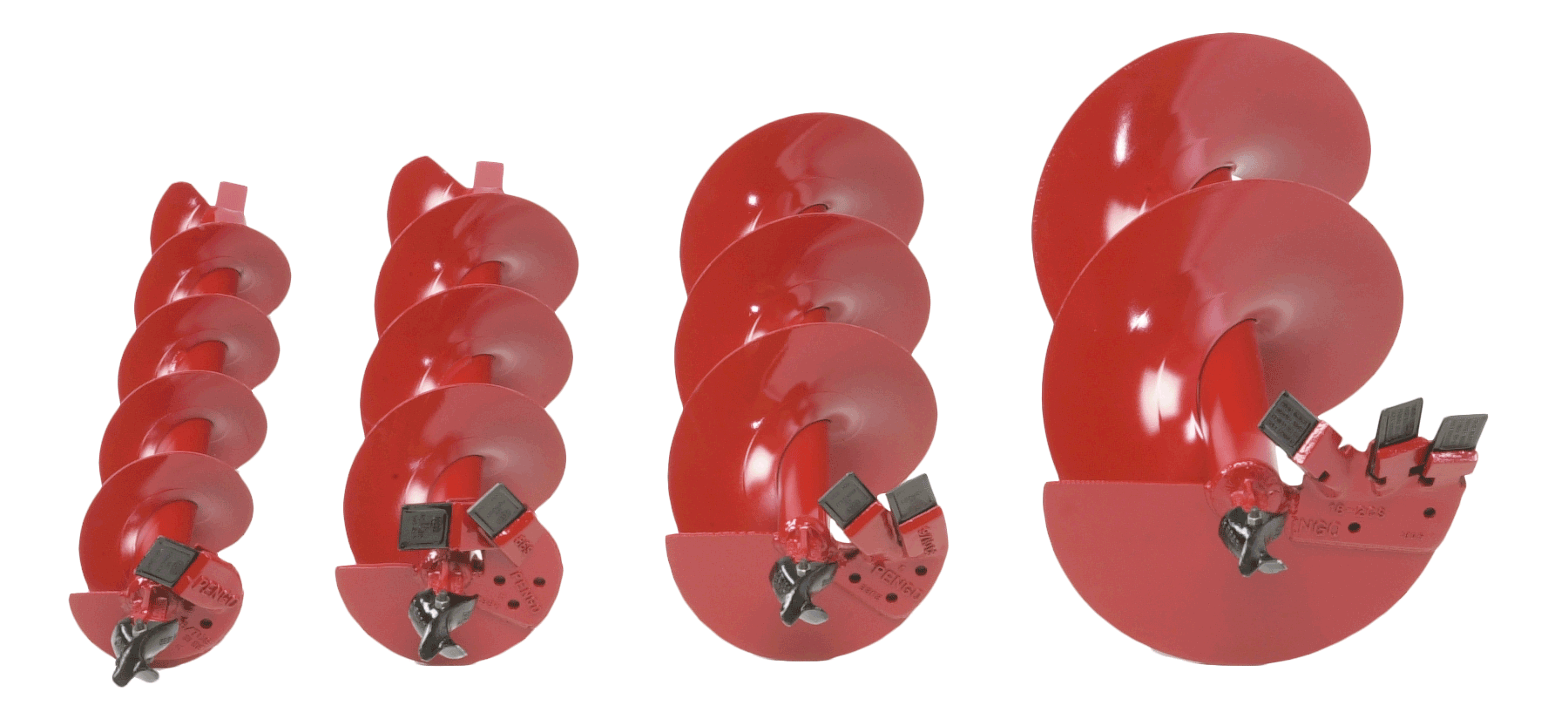
Matching the ideal point and blade to the soil and digging project can eliminate premature wear while reducing maintenance and boosting satisfaction for rental customers.
Unlike many manufacturers that only make one auger, Little Beaver offers a variety of augers, points and blades designed to optimize cutting in any soil for any project. Here’s a quick guide for setting your customers up for success.
Determine Auger Strength
Standard augers are excellent for a majority of projects and excel in soft soils. Little Beaver’s standard augers can also be used in clay, frozen ground and for drilling through hardpan soil. However, the tips and blades should be changed to match the conditions.
For drilling in rocky soils, always recommend heavy-duty augers to avoid damage. These augers are equipped with a more durable tooth and side cutting blades as well as heavy-duty flighting.
Diameter & Depth
Little Beaver offers 13 different auger diameters, from 1.5-inch diameter augers used for soil sampling, to large 16-inch nursery augers. As the diameter increases, more power is required from the drill. Setting customers up with a drill that has a gear reduction will result in more efficient drilling when using large diameter augers.
For projects that require digging deeper than standard augers allow, Little Beaver offers snap-on extensions available in both full-flighted and tube versions.
Points and Blades
Six different blade options are available to meet any drilling condition. The standard blades and points are ideally suited for loamy soils or areas with few rocks. They are made with cold-rolled steel and hard surfacing to their edges.
To drill through hard clay or frozen ground, Little Beaver’s carbide blades are more effective. For abrasive soils and compacted rock, Little Beaver’s heavy-duty augers are specially designed with heavy-duty steel and carbide blades and tips.
Convenient Components
Little Beaver’s snap-on augers and extensions use convenient spring-loaded snap buttons, allowing customers to switch augers quickly without needing tools.
Most Little Beaver points and blades attach to the auger with two easy-to-remove steel bolts. Little Beaver points and blades can easily dig more than 100 holes before requiring maintenance. Reversible blades are also available. These can be flipped over for a fresh cutting edge to last twice as long as regular blades. Need help picking the right augers, points and blades for your jobs? Connect with our Little Beaver experts today.
Watching a blimp soar overhead — whether operated by the military or a corporation — can be an awe-inspiring sight. After all, the airships contain enough helium to fill more than three-quarter million balloons. But, that doesn’t actually make them all that lightweight.
So, how does a crew secure a 10-ton airship filled with 200,000 cubic feet of helium once it lands? With a fast-moving crew, strong ropes and heavy-duty anchors. But how the crew secures the ropes and anchors can vary.
Slow and Cumbersome
For years, ground crew teams have relied on gas-powered crank units — often called anchor crankers — to drill the anchors into the ground that secure the airships. At takeoff, the crews wrench the anchors out by hand — a slow and cumbersome process that can cause arm and back strain.
Crews knew there must be a faster, less strenuous way to keep a 250-foot-long airship secured. One such crew turned to Little Beaver, a longtime earth drill manufacturer, to see what type of customized solution the Texas-based team could provide.
High–Torque Alternative
Little Beaver recommended switching to hydraulic earth drills since their high torque allows for easily drilling in nearly any soil — a key feature for airships, which regularly land at different locations across the United States.
Coupling the drill with Little Beaver’s anchoring attachments and anchors allowed the airship’s ground crew to easily secure each anchor in less than a couple of minutes. When it’s time to move to the next location, operators simply use the drill’s reverse gear to remove the anchors. This speeds up the takeoff process and eliminates back-straining work.
The airship’s ground handling crew can now install and remove anchors for each ship in the fleet in less than a half hour. It’s saved hundred of hours each year for the crew compared to their former anchoring methods.
A “Grounded” Solution
Additionally, since ground crews work outside, Little Beaver made custom handles to enhance operator safety during inclement weather. Working with customers to develop one-of-a-kind solutions to unique challenges is not uncommon for Little Beaver. In this case, they made handles using fiberglass instead of steel to reduce susceptibility to lightning strikes.
While airship anchoring is not a huge market, Little Beaver drills offer the versatility and customization necessary to anchor anything from airships and mobile homes to utility poles and party tents. And the next time they receive a custom request for a specialized anchoring system, Little Beaver engineers are confident they can create a solution.
Routine preventative maintenance is crucial. It boosts uptime and ROI for earth drills, which means faster project turnarounds and hassle-free hole digging — all while reducing your service costs.
To help you stay a step ahead of your drill’s maintenance, our Little Beaver team created a video series that aims to reduce downtime and increase service life for your equipment. In addition to step-by-step maintenance instructions, the videos provide information regarding best practices and tips for getting the most out of your drill.
Learn how to properly set up the Little Beaver mechanical earth drill for fast success starting your projects, whether it’s installing a fence, building a deck or planting a row of trees. Follow along as Randy VanWagner, our engineering manager, demonstrates the step-by-step process for setting up the drill as well as disassembling it for transportation or storage.
An increasing number of rental centers are unearthing a demand for Kwik-Trench mini-trenchers. The Kwik-Trench Earth Saw from Little Beaver is easy to use and ideal for a variety of applications, including installing sprinkler systems, electronic dog fences, landscape edging and cables. With its safe, compact, push-forward design, Kwik-Trench has proven to be the fastest and most economical mini-trencher on the market.
Along with being fast and user-friendly, Kwik-Trench allows renters to dig in areas that are inaccessible to large trenchers. Kwik-Trench also minimizes cleanup and simplifies backfill by depositing soil neatly along the edge of the trench.
Capable of cutting up to 30 feet per minute, and digging as deep as 12 inches, Kwik-Trench can conquer many of the jobs that renters would typically use a large trencher for. Plus, it requires less maintenance than bigger trenchers, so it’s ready to re-rent faster.
With a smaller price tag and the ability to handle a wide range of trenching applications, rental centers are Kwikly discovering the value of mini-trenchers. To locate a dealer, contact sales@littlebeaver.com.
We use cookies to ensure that we give you the best experience on our website. If you continue to use this site we will assume that you are happy with it.