Routine preventative maintenance is crucial. It boosts uptime and ROI for earth drills, which means faster project turnarounds and hassle-free hole digging — all while reducing your service costs.
To help you stay a step ahead of your drill’s maintenance, our Little Beaver team created a video series that aims to reduce downtime and increase service life for your equipment. In addition to step-by-step maintenance instructions, the videos provide information regarding best practices and tips for getting the most out of your drill.
Learn how to properly set up the Little Beaver mechanical earth drill for fast success starting your projects, whether it’s installing a fence, building a deck or planting a row of trees. Follow along as Randy VanWagner, our engineering manager, demonstrates the step-by-step process for setting up the drill as well as disassembling it for transportation or storage.
Never let poor productivity of handheld equipment and the risk of disturbing the turf with skidsteer tracks slow down your landscaping business. Whether you’re installing fence posts, planting trees or soil sampling, using an earth drill helps you work faster with minimal impact to the customer’s lawn. Here’s how earth drills maximize your productivity.
Features that protect the operator and equipment also save your budget. Paying workers’ compensation, or shop repairs can have a huge impact on your bottom line. Avoid dangerous kickback to the operator with a steel torque tube on mechanical and hydraulic models. The torque tube transfers drilling torque from the drill head to the engine carriage, virtually eliminating the risk of kickbacks to the operator as well as damage to the transmission and drive cable. Traditionally, contractors used two-man hole diggers, but choosing a model with a torque tube cuts labor costs in half. Another safety feature found on hydraulic units is a pressure-relief valve to stop the machine if hydraulic pressure reaches unsafe levels. More safety and less downtime equals greater productivity.
Accuracy and speed are fundamental for completing more projects. Manually digging holes is a tedious and inefficient process. Drill several feet deep in seconds rather than minutes with Little Beaver’s mechanical and hydraulic drills. Mechanical drills achieve speeds as fast as 360 RPM and hydraulic drills reach 285 RPM.
Comfortable and convenient features lead to more productivity. Avoid throwing the towel in early due to operator aches and pains. If you hit an obstacle, hydraulic earth drills feature a comfortable one-touch reverse control to help you back out without having to manually lift the dirt and auger on your own. And, padded handles, easy access to the throttle controls and on/off switches on mechanical and hydraulic earth drills ensure a comfortable operation.
Simple maintenance equals less downtime. Easy servicing ensures that equipment is always ready to go and helps protect your equipment against wear. An earth auger with easily replaceable and reversible points and blades keeps the project running smoothly by cutting through a variety of soils and extends the auger’s service life.
Easy maneuverability is key to getting around the worksite. Bulky equipment, such as skid steers, are difficult to maneuver through tight spaces and might require following up with handheld tools to get the job done, which can eat up valuable work hours. Compact mechanical or hydraulic earth drills with wheeled power sources, on the other hand, easily access narrow side yards. The pneumatic tires, coupled with the drills’ light weight, prevent lawn damage and make them easy to move. Save valuable truck or trailer space for hydraulic earth drills by using a 2-inch ball hitch for transporting. Or, for additional hauling options, cut the weight in half by unhooking the removable power pack for easy loading and unloading.
Here are some products that can help you be faster and safer as well as grow your job list. Have more questions? Contact us.
A little maintenance work goes a long way to decrease costs, expand the lifespan and enhance the power of your earth drill. Contractors choose our Mechanical Earth Drills for high power in a variety of applications such as fence installation, deck installation or landscaping. Like most equipment, a mechanical drill requires simple, routine maintenance to stay up and running. By maximizing uptime, you’ll generate higher profits across the board from your landscaping projects.
Earth Auger Maintenance Basics:
Transmission/gearbox: Every 30 days, or after 40 hours of use, verify the transmission oil level offers adequate lubrication. Low oil can cause excessive gear wear.
Flexible Drive Shaft: Examine, clean and grease the flexible drive shaft after every 50 hours of operation. Apply sufficient grease so that it’s not gumming up the flex shaft but not so little that it’s dry and puts the cable at risk of breaking.
Clutch: Check the clutch every 30 days or when you lubricate the flexible drive shaft. Clean the shoes and drums and replace if any clutch padding is missing. A worn clutch can slip or cause the drill to jerk. Worn springs might result in the auger spinning at idle or overheating.
A Comprehensive Approach
While these are the most frequent maintenance areas, it’s important to keep other components on your radar, as well. Be sure to monitor other parts, including the throttle, torque tube, augers, points and blades, and the engine to identify any potential issues.
To learn more about warning signs and maintenance tips, check out our online service videos. They offer step-by-step guidance on Little Beaver maintenance protocols. You can find further advice in our product manuals as well as our blogs.
You can also contact us directly regarding any technical issues. Our dedicated support team is just a click or phone call away.
Selecting the Best Earth Drill & Accessories for Your Project
An earth drill is an excellent tool for a variety of projects, from installing fence to planting trees and creating irrigation systems. It can also be used for anchoring mobile homes, large tents and utility poles. Notice the diversity of work that can be accomplished using this singular tool. While these projects may appear similar because they all demand a hole, drill beneath the surface and you’ll find that soil composition makes a big difference in what power option and style of auger is best for the task at hand.
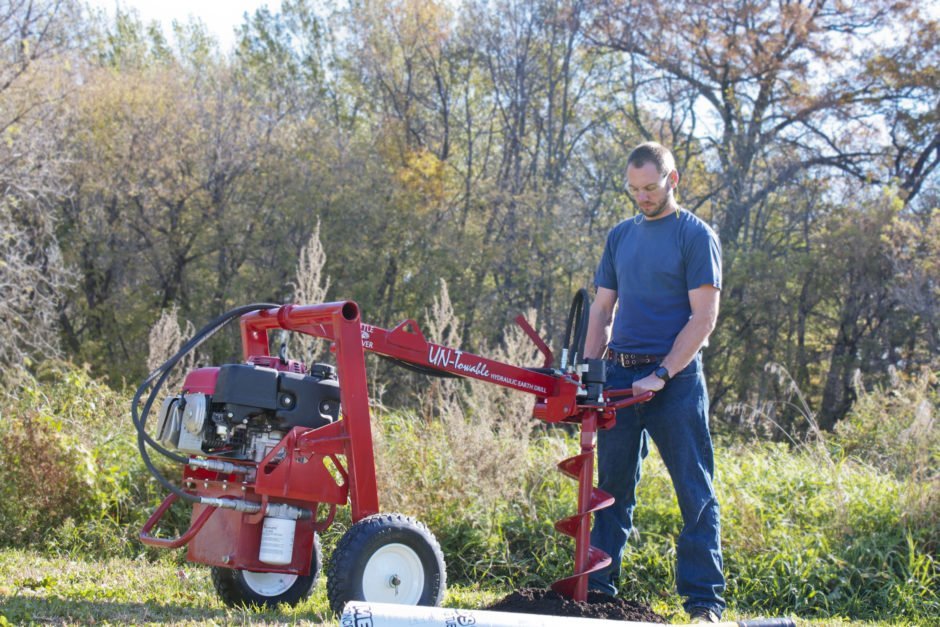
Taking a few minutes to understand the different drill types and components will win you enhanced productivity on the jobsite. You can choose between two types of engine-driven, one-man earth drills: hydraulic or mechanical. They might look alike, but each post hole auger was designed for a distinct purpose.
Hydraulic Power
Hydraulic earth drills are your best option for the toughest layers of sediment, including frozen ground and rocky soil. They have approximately double the torque of mechanical models. Little Beaver’s hydraulic machines have rugged bodies and powerful torque to punch through stony sediment. Precise, low-speed operation coupled with high torque allow the operator to drill clean and accurate holes, even in the most difficult applications.
Hydraulic drills are ideal for single-hole projects such as installing signs and planting trees because they’re compatible with large-diameter augers, some as wide as 16 inches. The torque makes them perfect for quickly anchoring mobile homes. Additionally, the drills typically have a reverse setting so you can safely remove the earth auger if it becomes lodged under a rock or tree root.
Mechanical Speed
Mechanical earth drills are more compact and lightweight, but still pack a powerful punch. When your project needs speed and precision, this drill is up to the task. This transmission-powered unit performs high-speed auger rotations at 360 rpm so you can quickly drill several, narrow holes for a wide range of applications, such as fence post fitting and deck footings, as well as planting flowers. Paired with an effective horizontal boring kit, it can also drill under driveways or sidewalks for a variety of landscaping needs.
Superior Safety
Most drills with 360 rpm speed require two operators to stabilize the unit. Both our mechanical and hydraulic drills have a torque tube that transfers torque from the auger to the power source, drastically reducing the risk of encountering dangerous kickback. This one-of-a-kind invention makes one-man drilling not just possible, but also safe and efficient. The torque tube reduces physical strength on the operator and enables safe operation regardless of drilling experience.
Auger Selection
Once you’ve chosen your drill type, it’s time to pick the auger that matches the required hole diameter. Augers can be as narrow as 1-1/2 inches for smaller jobs like soil sampling, and wide as 16 inches for large applications, such as foundation repair. Little Beaver’s snap-on augers can make changing out the auger or attaching extensions a quick and easy process. They feature a spring-loaded snap button, which secures the auger to the drill head. This reduces set-up and take-down times. This connection method simplifies the process of adding extensions, which enables the operator to dig a few feet deeper without needing to purchase a longer auger.
Contractors and landscapers should also look for augers that have swappable points and blades. Standard blades are ideal for loamy soils or areas with few rocks because of the cold-rolled steel and hard surfacing on the edges. Use Little Beaver’s carbide blades for drilling in denser soils. They equip the earth auger to chop hard clay and frozen ground into pieces. Swap out the blades using an adjustable wrench. These modifications enable an auger to drill more than 100 holes in prime soil conditions before needing service.
An Essential Tool
Whether you are a seasoned construction pro or a do-it-yourself weekend warrior, the one-man auger is a timesaving, indispensable companion in your arsenal of tools. Outfitted with Little Beaver’s reliable drill designs, you can tackle drilling projects in a fraction of the time you would with a shovel.
Nothing says summer like a backyard barbeque on your new deck. When built correctly, the deck can be a hot spot for many backyard escapes and a refuge for enjoying perfect summer evenings. But it all can come crashing down if the deck doesn’t have proper footings.
Footings support the deck’s weight at different points in the ground, creating a crucial support network that prevents problems, such as sagging and wood rot. Those problems not only make your deck unattractive, but unsafe as well. And to fix them as they surface taps your savings and generates unwanted stress. Without proper footings, the deck will sink into the ground, taking with it any future summer get-togethers.
Laying the Groundwork
When starting a new deck project, choosing the correct footings boils down to two things, loads and codes. The first step you should take is to determine the deck’s size, location and layout. After getting a general idea of what you want the deck to look like, think how will you use it. Will it be the next venue for the neighborhood block party? Or will it be for intimate gatherings of family and friends? Based on your answer, your deck will have different footing requirements because of the weight requirements.
Local building codes also determine the footing style and measurements. Building codes can vary state to state, so it’s crucial to contact local government experts. They can provide information regarding the minimum number of footings needed, spacing requirements and even how deep to dig. For instance, holes need to be dug below the frost line, which can range anywhere between 12-60 inches, depending on where the project is within the U.S.
The Digging Commences
After securing the necessary building permits from city hall and locating underground utility lines, it’s time to dig. When it comes to bringing heavy duty equipment through your yard, let’s face it. You’re not thrilled about skidsteers leaving ruts in your soft, green grass, and fences and narrow side yards limit what type of equipment can even reach the worksite — commonly forcing homeowners to seek out hand augers and mechanical drills.
Mechanical earth drills, which can be rented from a local rental business, can get to the site, not to mention save time when digging deck footings. These earth augers can cut through different soil types, dig clean, consistent holes and quickly set up the beginnings for the perfect deck. Earth drills are compact and offer multiple types of digging teeth depending on the types of soil you have.
Additionally, mechanical drills are more portable than heavy machinery. For instance, some drills feature pneumatic wheels so a single person can pull the drill and carriage to the footing location without forming lawn ruts or dismantling fences. Some manufacturers build models with torque tubes that transfer digging torque to the engine carriage, which allows one person to safely operate the drill. Once in place, the user can drill to the required depth and quickly move to the next footing location.
After the footings are placed and the concrete has set, you can continue building the frame for the deck that will be the hot spot next summer and for many more to come.
We use cookies to ensure that we give you the best experience on our website. If you continue to use this site we will assume that you are happy with it.


 An earth drill is an excellent tool for a variety of projects, from